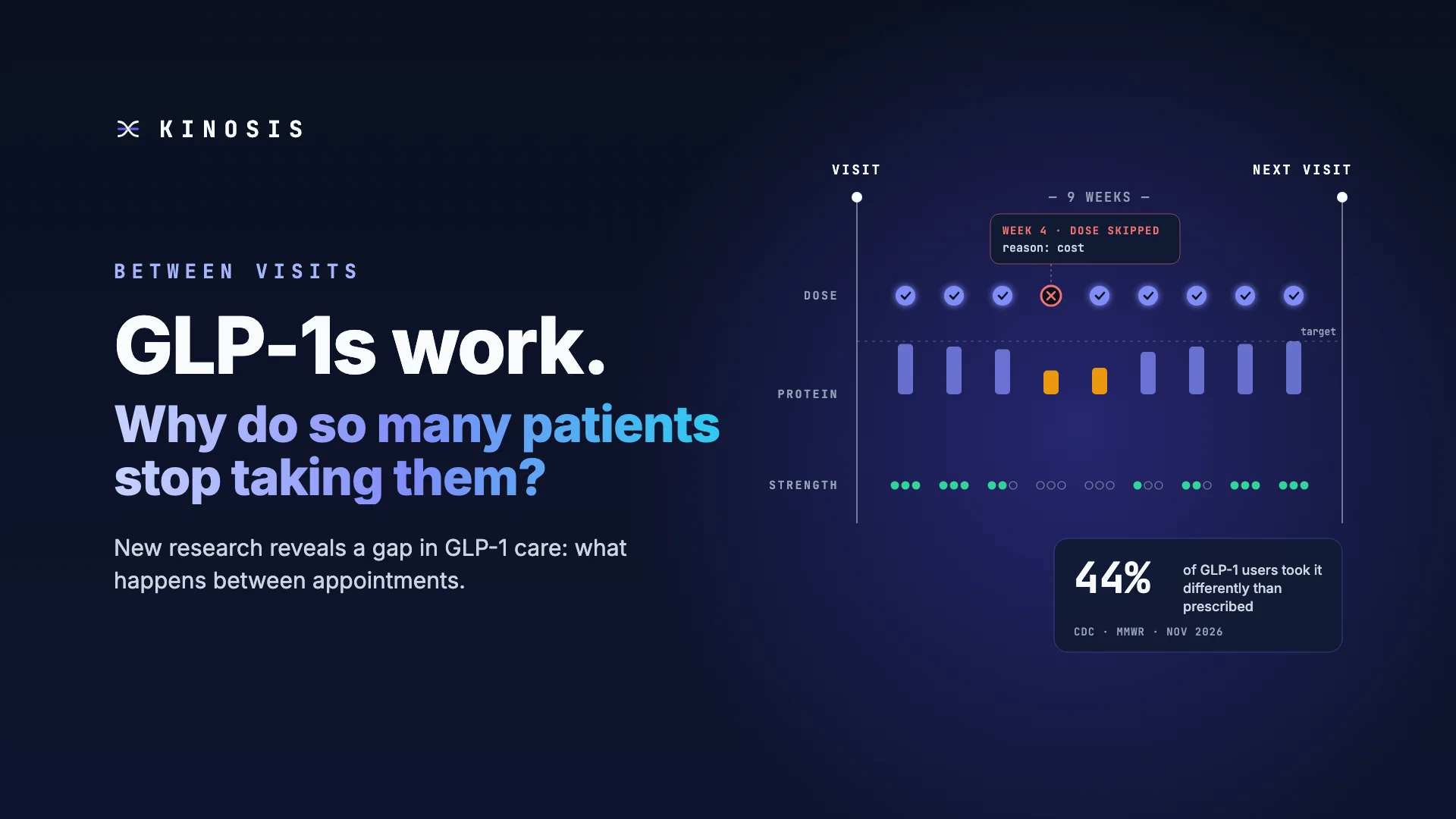
In November 2026 the CDC reported that 44% of US adults who used a GLP-1 medication in the past year took it differently than prescribed. Skipping doses was the most common change; others took less or delayed refills. (CDC, MMWR, November 2026)
The problem isn’t necessarily that the medication doesn’t work. It’s that the treatment plan can break down between appointments.
Take Laura, 46. She has lived with obesity for most of her adult life, and every diet and program she tried ended with the weight back. Eleven weeks into a GLP-1, she is down ten pounds and starting to believe this time is different. Then the dose goes up and the nausea returns. On the bad days she lives on crackers, and she has stopped the strength sessions her doctor asked for. The next box could take three weeks, and since her insurance stopped covering it, she pays for every box herself. On Thursday night, injection day, she decides on her own to skip a dose and stretch what she has.
Her next visit is in nine weeks. Unless she calls, her care team won’t know until then. By then she may have skipped three doses, or stopped, and the record may not capture why.
Laura is fictional. What she is about to do is not, and every number in this article comes from a cited source. The CDC estimate is nationally representative, from a survey fielded in July and August 2025: about one in ten US adults (9.8%) used a GLP-1 in the past year, and 28% of users skipped doses.
GLP-1 medications can be highly effective. But what happens between visits can determine whether patients realize their full benefits.
Why people change the plan, and what it costs
The reasons are practical. Among people who changed how they took the medication, 38% cited cost and 36% availability. About 12% of all users cut back or stopped because of side effects. Younger adults changed their use most: 54% of those aged 18 to 39, against 30% of those 65 and older. Among younger adults who changed, 58% cited cost, and 37% of younger users had delayed a refill, against 6% of older users. (CDC) More than half of users (56%) tell KFF the drugs are difficult to afford, including 55% of those with insurance. (KFF, 2025)
These numbers have limits. The CDC figures are self-reported, from one survey in mid-2025, and they say nothing about what clinicians knew. The health-record and claims studies below are large cohorts, not national samples.
Compounded versions widen the gap. About one in five users (22.6%) took one, and 62% of them changed how they took it, against 36% of people on approved products. Another 8.8% didn’t know whether their medication was compounded: roughly one user in eleven can’t say what they are injecting. (CDC) The FDA has reported dosing errors from patients measuring their own compounded doses, some leading to hospitalization. (FDA) A plan that doesn’t record which product the patient is actually using can’t account for any of this.
Changing the plan often comes before stopping it. In health records from a large US research network (125,474 adults with overweight or obesity, not a national sample), just over half (53.6%) stopped their GLP-1 within a year: 46.5% of those with type 2 diabetes and 64.8% of those without. Gastrointestinal side effects raised the risk of stopping. (JAMA Network Open, 2025) Persistence can improve. One pharmacy-benefit analysis, not peer-reviewed, found that one-year persistence on the newer high-potency obesity medications nearly doubled, from 33% for 2021 starters to 63% for 2024 starters. It says shortages resolving likely explain most of the rise, and names better dose escalation, side-effect management and care programs as other possible reasons. (Prime Therapeutics, 2025)
In trials, fewer than one in ten participants stopped because of gastrointestinal effects, with doses stepped up under close follow-up. (Obesity, 2025) In daily life, 13% of users say they stopped because of side effects, and 14% because of cost. (KFF, 2025)
Stopping has a price. In the STEP 1 trial extension, people who stopped semaglutide regained about two-thirds of the weight they had lost within a year. (Diabetes, Obesity and Metabolism, 2022) Routine care is messier: in a Cleveland Clinic study, 27% of people who stopped switched to another medication within a year and 20% restarted the original one. (Cleveland Clinic, 2026) These changes can be difficult to reconstruct at follow-up visits.
The dose is only one line of the plan
A GLP-1 plan that works is more than an injection. In the STEP 1 trial, body composition was measured by DXA scan in a substudy of 140 participants (NEJM, 2021); by the joint advisory’s calculation from those results, about 38% of the weight lost was lean mass. Lean mass is not the same as muscle: it also includes water, organs and other non-fat tissue, and studies vary widely. (Diabetes, Obesity and Metabolism, 2024) That 2025 advisory, from four obesity, nutrition and lifestyle-medicine societies, recommends treating the rest of the plan as part of the treatment. Its recommendations include an absolute target of 80 to 120 grams of protein a day, strength training at least three times a week plus 150 minutes of moderate aerobic activity, and regular checks on what patients eat and drink. (Obesity, 2025)
Those parts of the plan can slip too. On a nauseous day, protein and water are easy to drop, and the gym is easy to skip. A patient who takes every dose but eats half the protein and skips strength training is following part of the plan, and nothing in the chart says which part.
The advisory names the fix: “digital engagement enables timely feedback to healthcare providers to adjust recommendations based on patient progress and feedback.” (Obesity, 2025) In other words, feedback on the whole plan, not only the dose.
The dropout problem happens between visits
A GLP-1 plan is not one decision. It is a weekly injection, a dose that steps up every few weeks, side effects that rise with each step, protein and fluid targets, strength training, and a supply the patient doesn’t control. Every week, the patient makes small decisions about all of it.
The care team sees few of those decisions. Follow-up visits may be weeks or months apart. In between, information arrives by chance: a portal message, a call to the front desk, a refill request. When a patient skips a dose to stretch a box, or lowers it because the nausea was bad, the chart still says what was prescribed.
That is an open loop. The plan goes out at the visit, the next measurement comes back weeks later, and what happened in between is rebuilt from memory. A weight plateau at week twelve could mean the dose is too low, three doses were skipped, protein fell away, or the strength sessions stopped. Without the weeks in between, the clinician has to guess which.
What closing the loop looks like
Digital follow-up can help close the loop without an extra visit each time: brief daily check-ins from the patient, and a short list for the team each day.
- The plan, item by item. The injection with its day, dose and exact product (approved or compounded), the titration steps ahead, protein and water targets, strength training and daily activity, and the side effects to watch. The clinician writes it once; the patient receives it as their plan.
- One tap on the day, and a reason when a dose is missed. A reminder arrives at injection time and one tap records the dose. If the patient doesn’t take it, they say why in one tap: cost, couldn’t get it, side effects, forgot. Each reason calls for a different response: a cheaper option, a supply plan, symptom management, a better reminder.
- The rest of the plan, measured too. A meal photo becomes an estimate of its protein. Water and strength sessions take one tap; steps and workouts sync from the phone or watch. Each item has its own adherence, so the patient who never misses a dose but eats too little protein shows up as clearly as the one who skips injections.
- Side effects in their own words. “Nauseous since Tuesday, barely ate” becomes a dated side-effect entry next to the dose step it followed. A dose missed because of side effects goes straight to the team.
- Who needs attention today. Adherence to every item, the reasons behind missed doses, side effects over time, and weight, protein and activity trends, ordered so the team contacts the right patients this week, not at the next visit.
Guidance for the patient, visibility for the doctor
Doing this through phone calls and portal messages is hard to sustain. It takes a tool built around the plan itself. That is why we built Kinosis: the plan the doctor prescribes lives in the patient’s app (or on WhatsApp), and the care team sees how it is going, day by day.
For the patient:
- The doctor’s plan, turned into daily steps: the injection and its dose, protein and water, strength training, the next visit, each with its own reminder.
- One tap to confirm, and one more to say why when something gets in the way.
- When the dose steps up on the schedule the doctor set, the plan updates and a short message explains the change.
- Questions answered from the doctor’s own instructions, with anything medical sent to the care team.
- Weight, steps and sleep from Apple Health, Health Connect, Oura or WHOOP; glucose from a CGM app; lab results read from a PDF.
For the doctor:
- Who is struggling before the next appointment, and why a dose was missed.
- The whole plan in one view: medication, nutrition, symptoms and activity, item by item.
- Whether it is working: weight, waist, glucose and labs, marker by marker.
- A summary of the weeks since the last visit, and a short list each day of who needs attention.
What Kinosis doesn’t do matters as much. It doesn’t prescribe, change doses or diagnose. It answers routine questions from the clinician’s own instructions and sends anything clinical to the team. Every decision stays with the clinician.
These are capabilities, not promised outcomes: no tool can guarantee that every patient stays on their medication. What changes is when the care team can find out. When a patient like Laura skips a dose because the box is running low, her team can know that week, and why.
Running a GLP-1 program? Your next Laura may already be on your list. With Kinosis, your team can know the week she skips a dose, and why, instead of at her next visit nine weeks later. Start a 14-day trial at kinosis.ai/providers. Taking a GLP-1 yourself? Ask your care team about Kinosis.
Juan Gargiulo is the founder and CEO of Kinosis.
Sources
- Pierce SL, et al. Use of GLP-1 Medications and Modified Medication Use Among Adults — United States, 2025. MMWR 2026;75(44). CDC, November 12, 2026. National survey, 8,118 adults, self-reported.
- Rodriguez PJ, et al. Discontinuation and Reinitiation of Dual-Labeled GLP-1 Receptor Agonists Among US Adults With Overweight or Obesity. JAMA Network Open 2025;8(1):e2457349. Health records, 125,474 adults.
- Urick B, et al. GLP-1 Therapy to Treat Obesity Among Members Without Diabetes: Three-Year Persistence. Prime Therapeutics, June 2025. Pharmacy claims, not peer-reviewed.
- KFF. Poll: 1 in 8 Adults Say They Are Currently Taking a GLP-1 Drug. November 2025. Survey, 1,350 adults.
- Wilding JPH, et al. Weight regain and cardiometabolic effects after withdrawal of semaglutide: the STEP 1 trial extension. Diabetes, Obesity and Metabolism 2022;24(8):1553–1564.
- Cleveland Clinic. What happens when patients stop taking GLP-1 drugs? March 12, 2026. Health records, 7,938 adults.
- Mozaffarian D, et al. Nutritional priorities to support GLP-1 therapy for obesity: a joint advisory (ACLM, ASN, OMA, The Obesity Society). Obesity 2025;33(8):1475–1503.
- FDA. FDA’s Concerns with Unapproved GLP-1 Drugs Used for Weight Loss. Updated October 1, 2026.
- Neeland IJ, et al. Changes in lean body mass with glucagon-like peptide-1-based therapies and mitigation strategies. Diabetes, Obesity and Metabolism 2024;26 Suppl 4:16–27. Narrative review.
- Wilding JPH, et al. Once-Weekly Semaglutide in Adults with Overweight or Obesity (STEP 1). NEJM 2021;384:989–1002. Randomized trial; body composition by DXA in 140 participants (Table S5).